
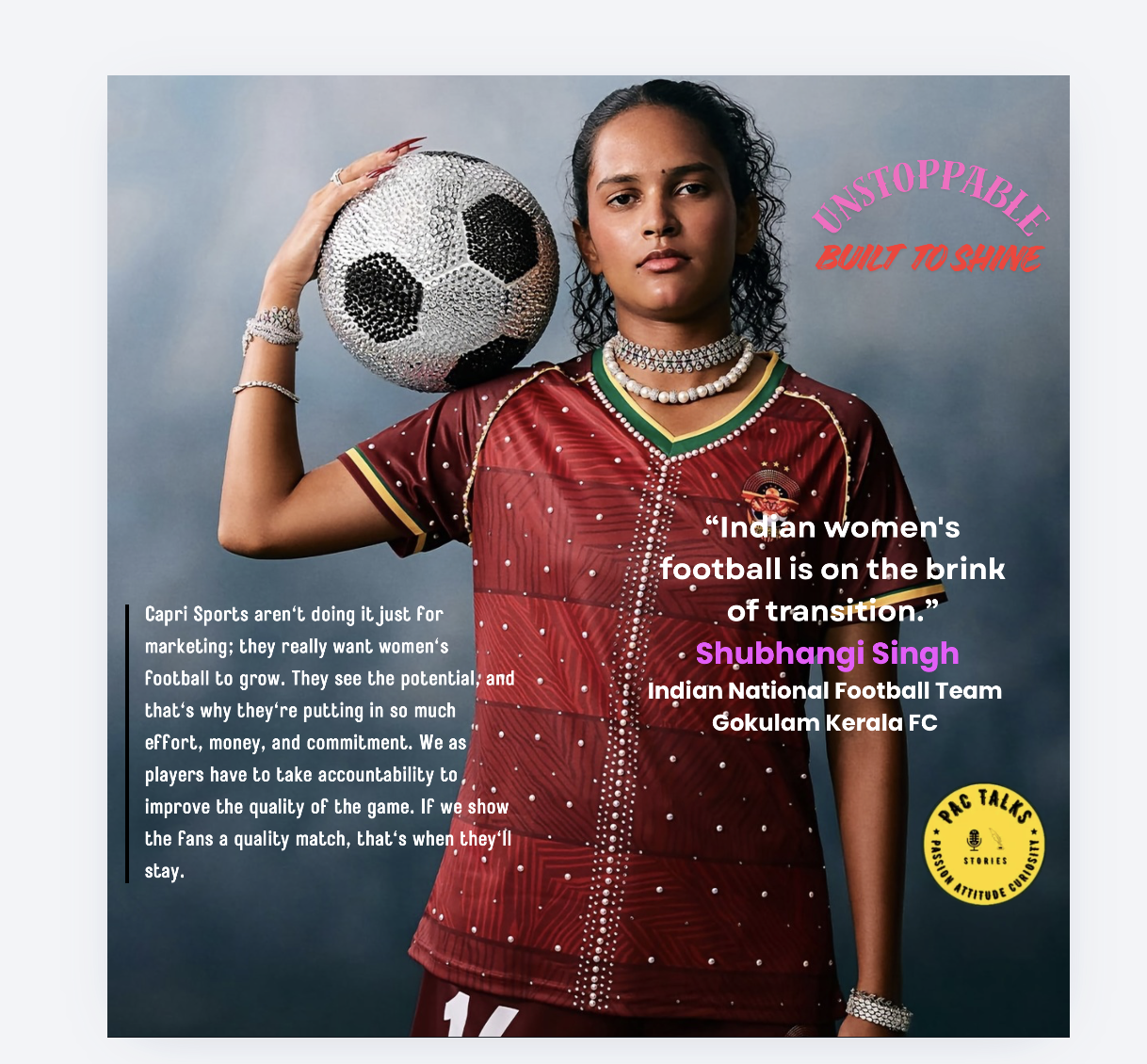
Shubhangi Singh has represented the U17 Indian national women’s football team and recently captained the India U20 Women’s National Team at the AFC U20 Women’s Asian Cup. Currently playing for Gokulam Kerala FC club in the Indian Women’s League and part of the Indian senior women’s national team. Shubhangi embodies the new face of Indian women’s sports—disciplined, highly articulate, and deeply committed to elevating the game.

In this episode of PAC Talks, Shubhangi reflects on her footballing journey, the mental resilience required to bounce back from ACL injury, the commercial evolution of domestic football, and what it truly takes to transform the sport in India. She also shared her thoughts on recent experience with the unique ‘Built to Shine’ campaign conceptualised by Capri Sports and how women’s football could benefit from the 15 years investment from them. Her story is a vivid demonstration of how Passion, Attitude, and Curiosity can challenge status-quo thinking and ignite long-overdue change.
Listen to the full podcast on Spotify , Apple.
The Spark of Passion: From Gujarat Grounds to the National Crest
Like so many female footballers across India, Shubhangi’s initial entry into football began with kicking a ball alongside her brother and his friends.
She earned a place at the Sports Authority of Gujarat (SAG) academy at around age fourteen. Her coaches recognised her defensive intelligence and encouraged her to set her sights on the national team.
By 2022, that ambition materialised when she represented India at the FIFA U-17 World Cup. Yet, when reflecting on her ascent, Shubhangi firmly rejects dramatic hardship narratives:
“My parents were the biggest supporters in my journey. I wouldn’t say I had struggles or hardships, because I didn’t. What I did put in was effort, hard work, and discipline to get where I am today.”
Her progression continued as she took on the captaincy of the India U20 squad, an experience she credits with sharpening her leadership and team management skills before earning her call-up to the senior national team.
Attitude Through Adversity: ACL Recovery, Senior Realities, and Calendar Challenges
Transitioning into senior football demands physical endurance and psychological resilience. After debuting in senior club football with Kickstart FC following the U17 World Cup, Shubhangi learned quickly that moving from youth football to senior setups requires patience. She subsequently joined Gokulam Kerala FC, where she is now in her fourth season.

However, her career hit a critical obstacle in 2024 when she suffered an Anterior Cruciate Ligament (ACL) rupture, sidelining her for a full year.
“An ACL injury takes a toll on your mind more than it is physically,” Shubhangi admits. “You’re not playing anymore; you’re just doing repetitive rehab every day. Mentally, it takes a lot. But Gokulam Kerala believed in me. They supported my rehab, brought me back, and after performing in the IWL, I earned my call-up for the under-20 team.”

Domestic Calendar Hurdles
Beyond individual setbacks, Shubhangi is candid about the structural friction facing Indian women footballers. The domestic IWL season currently spans just two months, leaving players with a ten-month competitive void. Furthermore, frequent scheduling shifts—such as dates moving from September to October, and then to mid-November—force players to train in isolation at home for months without match practice.
“It takes a lot to play as a woman footballer in India,” Shubhangi explains. “When the league is only two months long, it’s not sustainable. Many players take up regular jobs to provide for their families, and you can’t blame them. To grow, we need a longer season—around five months—with a predictable calendar so players don’t lose the joy of the game.”
The Change: Capri Sports & The “Built to Shine” Revolution
Shubhangi spoke very positively about the commercial shift taking place in the Indian Women’s League. With Capri Sports establishing a landmark 15-year commitment and All India Football Federation outlining plans to expand the league to ten teams by 2028, investment is beginning to alter how female athletes are presented.

The launch of the “Built to Shine” campaign—a 1.5-day high-fashion shoot led by Capri Sports leadership (including Jinisha Sharma), sponsor partners like Lxme Official, and styled by Bollywood stylist Aakruti Sejpal—reimagined IWL players completely. Dressed in Gokulam Kerala jerseys adorned with pearls, statement gold jewelry accents, and customized embellished boots, Shubhangi and her peers stepped into a new visual narrative.

“What I liked most about the ‘Built to Shine‘ campaign is that there was no victim story,” Shubhangi highlights. “Stories about women’s football usually revolve around ‘they don’t get enough attention’ or being the second choice. This campaign focused strictly on us as athletes—unstoppable and built to shine.”


The campaign has gained worldwide traction when Australian superstar Sam Kerr shared it across her global social media channels, giving Indian women’s football unprecedented international visibility.

Curiosity, Basics, and Player Accountability
Having faced world-class teams like Japan, Shubhangi observed the stark differences in technical infrastructure—from sideline digital analysis tablets to comprehensive sport science setups. However, she argues that India’s immediate priority must focus on foundational basics rather than high-end technological shortcuts.

“All technology is helpful, but first we need to get the basic things right before moving forward,” she notes. “We need quality grounds, year-round pitch availability, sustainability, and grassroots youth development.”
As the sole player from Gujarat currently in the national team setup, Shubhangi knows firsthand how difficult it is to find proper training grounds during the off-season. Yet, while advocating for structural improvements, she insists that players must also take ownership of their role in growing the sport:
“I won’t just blame the system, because we are part of this setup too. We as players have to take accountability to improve the quality of our play. If we show the fans a good, high-quality match, that’s when they will stay.”
Rapid Fire & Looking Ahead
To wrap up our conversation, Shubhangi shared some of her personal football influences and preferences:

- Domestic Role Model: Dalima Chibber (fullback) & Manisha Kalyan (playing in Europe and the UEFA Women’s Champions League).
- International Admiration: Yui Hasegawa and Chloe Kelly.
- Favorite Indian Club: Bengaluru FC.
- Dream International Destination: Arsenal Women.
- Tactical Preference: “It’s better to keep the ball than just defend. I’d rather go score another goal than defend a 1-0 lead!”
- Dressing Room Vibe: Upbeat party tracks over pre-game motivational speeches.

When asked to summarize the current trajectory of Indian women’s football in a single phrase, Shubhangi chose her words deliberately:
“We are on the brink of transition.”
Indeed, Indian women’s football is in the brink of transition. Significant efforts are taken by Capri Sports to elevate the game to next level with a 360 degree change in the way things are managed around women’s football. Bringing on board Lxme as a title sponsor for IWL is also a game changer and Priti Rathi Gupta has a similar view point in terms of enhancing women’s football which will surely compliment the plans laid out by Capri.
With young leaders like Shubhangi Singh combining technical dedication with authentic accountability, Indian women’s football is moving toward a future that is truly built to shine.
Hope to see some amazing games at IWL 2026 season.


Leave a Reply